UK Visa Interview Questions: What Indian Tourist Visa Applicants Should Know
Table of Contents8 sections
Many Indian travellers prepare for a UK tourist visa expecting an embassy interview, because that is how a US visa works. For the UK, it usually isn’t. Most UK tourist visa applications are decided entirely on the online form and the documents you submit.
That said, the UK can contact any applicant if something in the application needs clarifying. This guide explains when that happens, the kind of questions you may hear, and what a clear answer sounds like.
Information checked in November 2026.
Kya UK tourist visa mein interview hota hai?
A face-to-face embassy interview is not a standard part of a UK tourist visa application from India.
Your visa application centre appointment is only for fingerprints, a photograph and your documents. The staff there don’t ask about your trip. See UK visa appointment and biometrics.
Formal “credibility interviews” are mainly used for UK student visas. For tourist visas, contact is occasional and usually happens for one reason: the decision-maker wants to clarify something before deciding.
When the UK may contact you
- A phone or video call during processing. This is usually short and focused, for example on the purpose of your trip or the source of a deposit. It can come with little notice.
- An email asking for more information. You may be asked for an additional document or a short explanation.
- Questions at the UK airport. Even with a visa, a border officer may ask a few questions on arrival.
Sample questions, with weak and clear answers
The examples below are illustrative, based on a typical applicant: a salaried professional from Pune visiting London and Edinburgh with his wife for 12 days.
“Why are you travelling to the UK?”
Weak: “For tourism.”
Clear: “A 12-day holiday with my wife. We’ll spend eight days in London and four in Edinburgh, and fly back on 24 May.”
“How long will you stay, and where?”
Weak: “Around two weeks, in a hotel.”
Clear: “Twelve days, from 12 to 24 May. We’re staying in a hotel in central London, then in Edinburgh. The dates are the same as in my application.”
“Who is paying for the trip?”
Weak: “We have enough money.”
Clear: “I’m paying from my own savings. My salary is credited to my account every month, and the trip cost is a small part of my savings.”
“There is a large deposit in your account. Where is it from?”
Weak: “My relative helped.”
Clear: “That’s from a fixed deposit that matured in March. I’ve included the maturity advice with my documents.”
See UK visa bank balance.
“What do you do in India?”
Weak: “I work in a company.”
Clear: “I’m a senior engineer at a manufacturing firm in Pune and have been there for six years. My leave is approved, and I’m back at work on 26 May.”
“Have you been refused a visa before?”
Weak: a hesitant “no”, when there was a refusal.
Clear: “Yes, a US visa in 2022. I declared it in my form. My circumstances have changed since then.”
For parents visiting children: “Who are you visiting?”
Clear: “Our daughter. She’s lived in Manchester for four years and works as a nurse. We’re visiting for the birth of her first child in July.”
See UK visit visa for parents.
What makes an answer convincing
Across all of these, clear answers share the same qualities:
- They match the application. Dates, figures and names agree with your form and documents.
- They are specific. Places, dates and reasons are better than general statements.
- They are honest. Any inconsistency, especially about previous refusals, does far more damage than the fact itself.
- They are brief. Answer what is asked, then stop.
- They come from knowing your facts. A memorised script sounds memorised. Knowing your own plan sounds natural.
For mistakes that often lead to such questions, see UK visa application mistakes.
Before, during and after a call
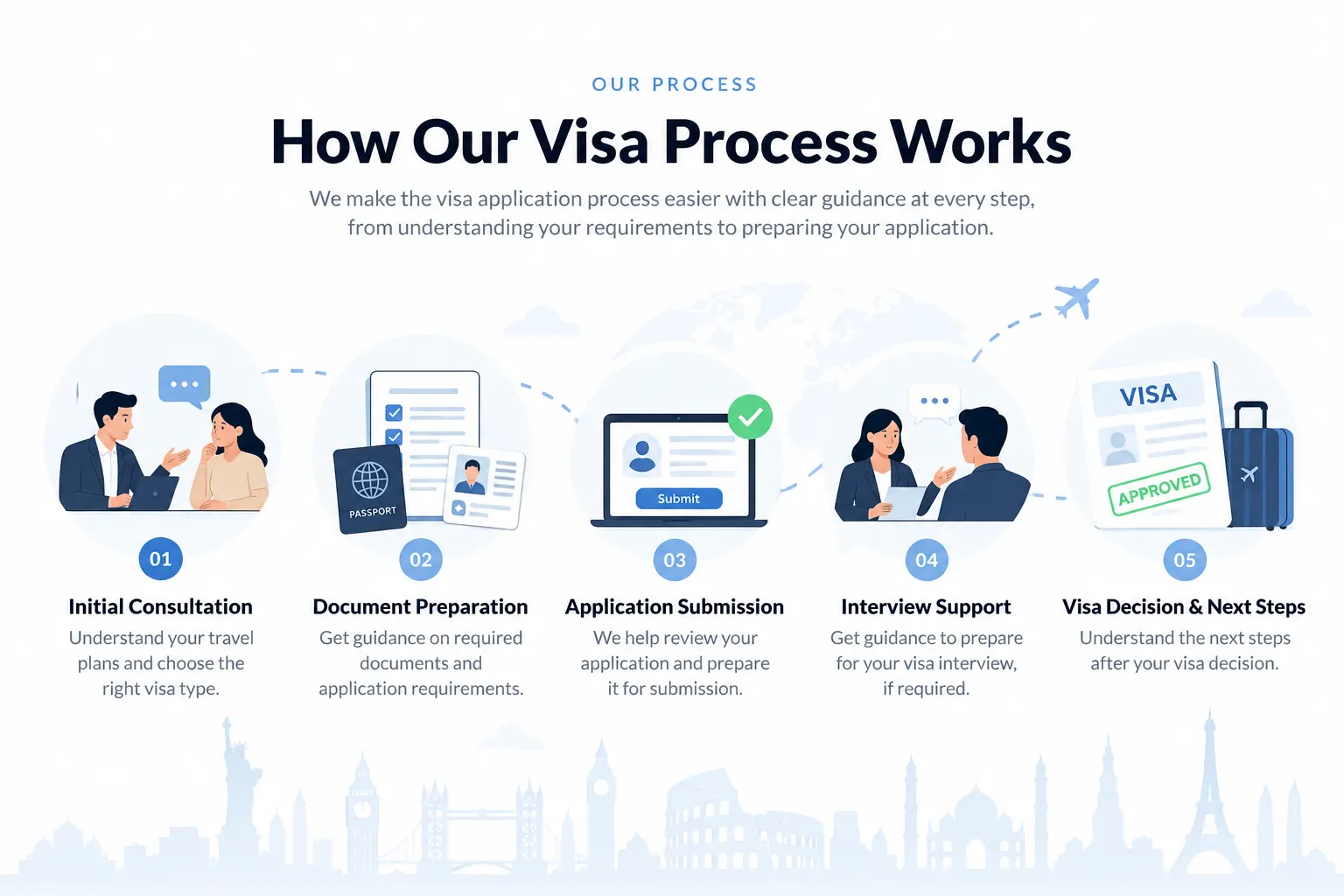
Before: while your application is being processed, keep your phone with you and check your email daily, including the spam folder. Re-read your form and keep a copy of your documents handy.
During: speak calmly and clearly. If you don’t understand a question, ask for it to be repeated. If you don’t know an answer, say so rather than guessing.
After: if you are asked for a document, send it promptly. If you missed a call, check your email for any follow-up.
A caution: if you receive a call or message you are unsure about, don’t share payment details. Genuine contact will relate to your application and reference number.
Common questions
UKVI call kyun aata hai?
Usually to clarify something in the application, such as the purpose of the trip or the source of funds.
Does a call mean my visa will be refused?
Not necessarily. It means the decision-maker wants more information before deciding.
Do visa centre staff ask interview questions?
No. The appointment is only for biometrics and documents.
What language is the call in?
Usually English. Ask for a question to be repeated if needed.
यूके टूरिस्ट वीज़ा में इंटरव्यू होता है क्या?
आमतौर पर नहीं। ज़्यादातर यूके टूरिस्ट वीज़ा आवेदनों का फ़ैसला ऑनलाइन फ़ॉर्म और दस्तावेज़ों के आधार पर होता है। ज़रूरत पड़ने पर अधिकारी फ़ोन, वीडियो या ईमेल से कुछ जानकारी स्पष्ट करने के लिए संपर्क कर सकते हैं।
The best preparation is a clear application
When your form, documents and plans tell the same story, most questions are answered before anyone needs to ask. A Visa Experts can go through your application with you, so you understand every detail in it. Book a Consultation or Talk to a Consultant.
For an overview, see UK visa from India. If you have been refused before, read UK visa rejection reasons.
UK visa ke baare mein aur padhiye
- UK Visa Form Kaise Bhare?
- UK Visa Application Mistakes
- UK Visa Appointment and Biometrics
- UK Tourist Visa Documents Checklist
- UK Visit Visa for Parents
- UK Visa Rejection Reasons
#uk visa interview #ukvi #uk tourist visa #visa tips